To Likeness or Not to Likeness
As someone who has been training AI image models for quite some time, I have been noticing a pattern in the real world, not in the models.
Expectations for what counts as a "real" image are perhaps changing, or at least a high level of realism is no longer expected, and that seems to be acceptable. This is interesting to observe because, with this new mindset, we are witnessing the emergence of a new aesthetic for our times.
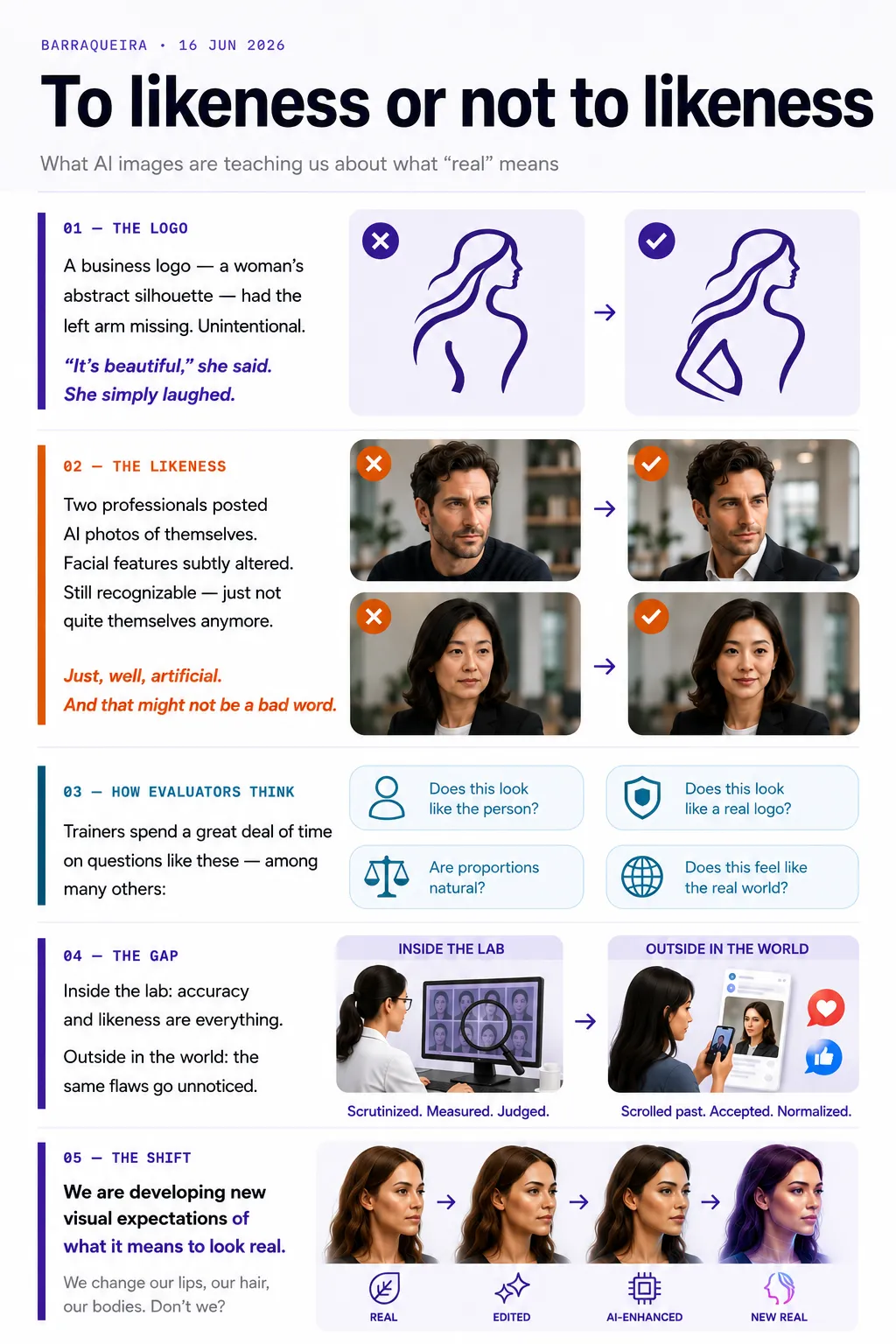
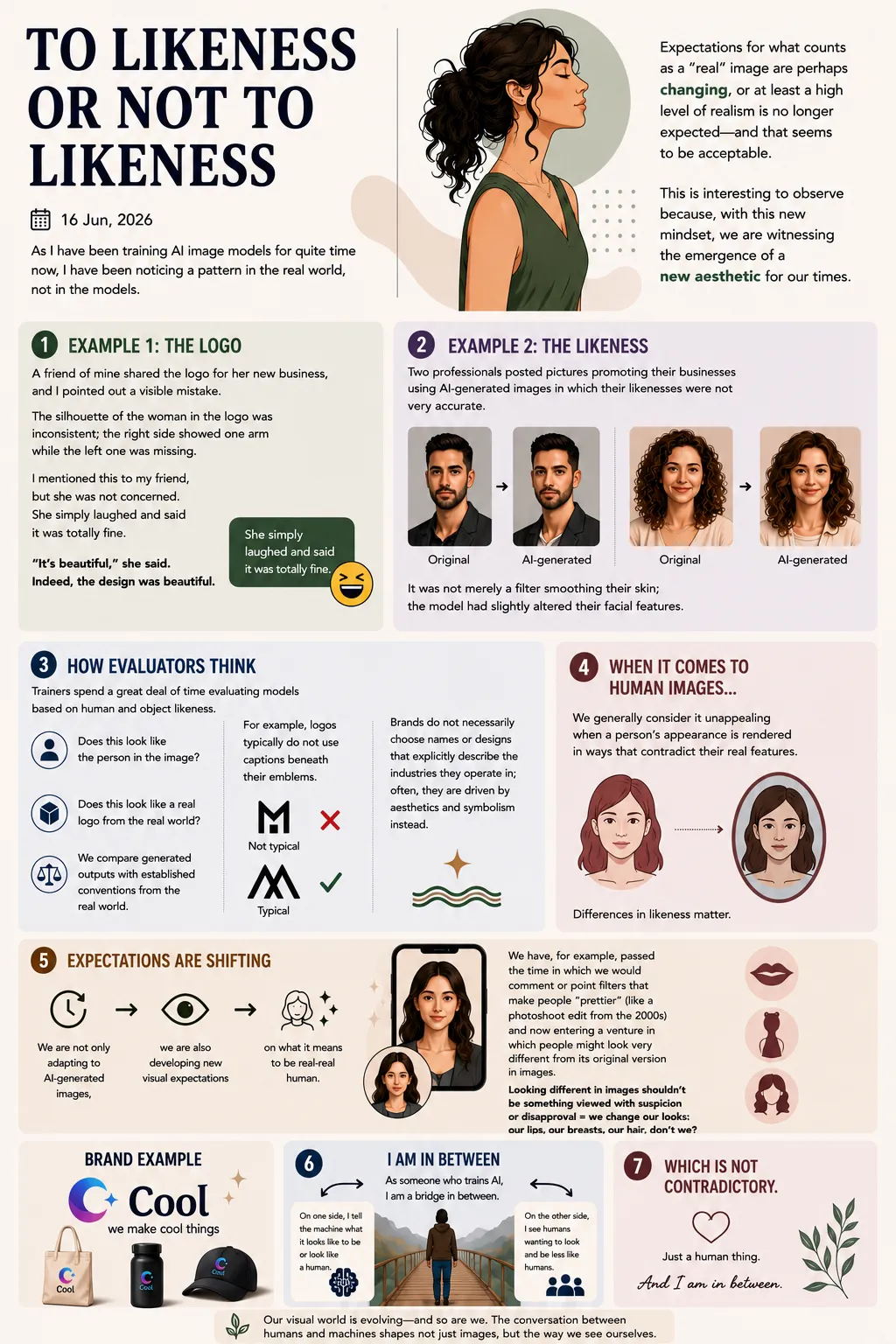
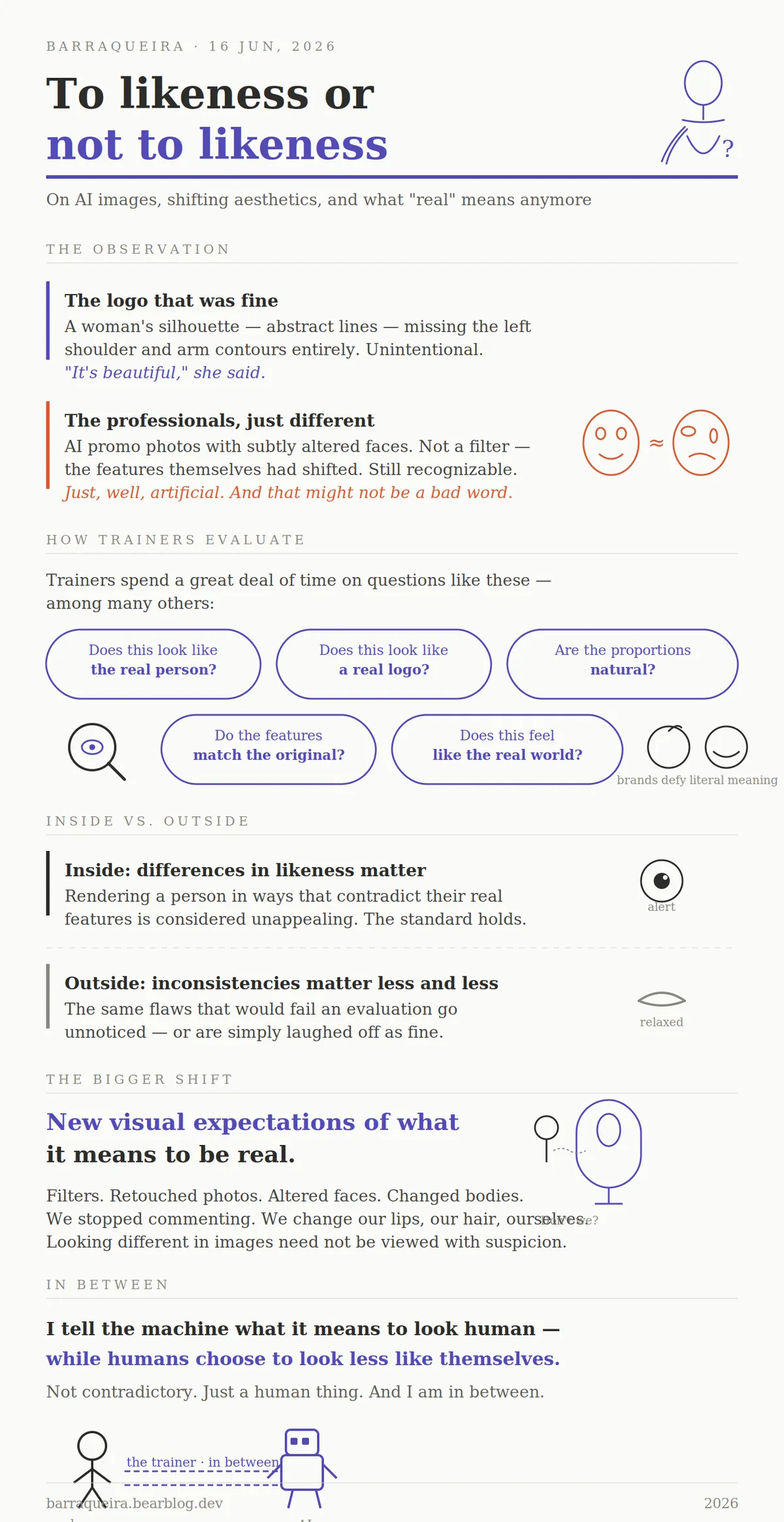
For example, a friend of mine shared the logo for her new business, and I pointed out a visible mistake. The silhouette made of abstract lines of the woman in the logo was inconsistent; the right side showed one arm while the left shoulder and the left arm contours were missing — and it was not intentional. I mentioned this to my friend, but she was not concerned. She simply laughed and said it was totally fine. It's beautiful, she said. Indeed, design was beautiful.
More recently, two professionals posted pictures promoting their businesses using AI-generated images in which their likenesses were not very accurate. It was not merely a filter smoothing their skin; the model had slightly altered their facial features. Still, the professionals were recognizable, just different. Just, well, artificial. And artificial might not be a bad word anymore.
Trainers spend a great deal of time evaluating models based on human and object likeness: Does this look like the person in the image? Does this look like a real logo from the real world?
As evaluators, we compare generated outputs with established conventions from the real world. For example, logos typically do not use captions beneath their emblems. Brands do not necessarily choose names or designs that explicitly describe the industries they operate in; often, they are driven by aesthetics and symbolism instead, as in the cases of Apple and Amazon. When evaluating human images, we generally consider it unappealing when a person's appearance is rendered in ways that contradict their real features. Differences in likeness matter.
Yet outside the evaluation environment, these inconsistencies seem to matter less and less. Perhaps we are not only adapting to AI-generated images — we are also developing new visual expectations of what it means to be real. We have, for example, moved past the era in which we would comment on filters that made people look "prettier" (like a retouched photo from the 2000s), and are now entering a space in which people may look quite different from their original selves in images. Looking different in images need not be viewed with suspicion or disapproval — we change our looks: our lips, our bodies, our hair. Don't we?
I have no conclusions about the direction human aesthetics will move toward. As someone who trains AI, I am a bridge and stand in between: telling the machine what it looks like to be human, while on the other side I see humans wanting to look, and perhaps be, less like humans. Which is not contradictory.
Just a human thing. And I am in between.
Two models. Different personalities, different mistakes, different brilliances:
They can't quite work together when merged